Parental responsibility and forgiveness
Anxious PeopleParental responsibility and forgiveness form a recurring tension between the care adults hope to provide and the limits their children eventually discover. Parents are expected to offer security, guidance, and presence, yet the narrative shows them failing, grieving, or being unable to control events. Children, meanwhile, may continue to love a parent without declaring that the parent’s choices were harmless. The concept is most sharply expressed in the Man on the bridge’s reflections on being judged by a single failure, and echoed in the Bank robber’s memories of a parent who hurt her and in Jack and Jim’s different ways of caring for a troubled family member.
The burden of being a parent
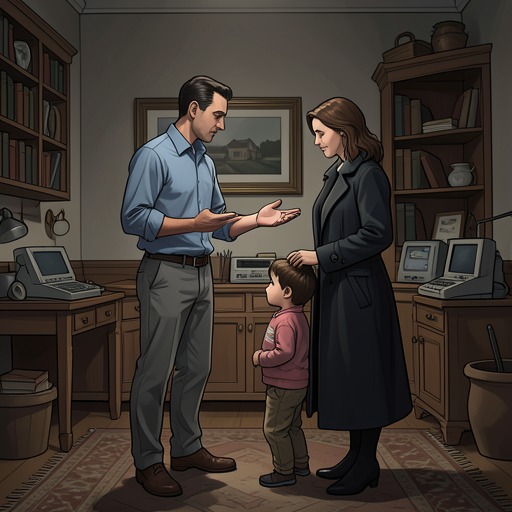
The Man on the bridge explains that he had tried to build a secure future for his children. He had held a good job, established a reasonably successful business, and bought an apartment. Hoping his children could have better jobs and homes, and avoid the exhaustion he associated with financial insecurity, he invested his savings in a real-estate development company. He understood a parent’s role as providing support: first helping children see the world, later giving them something to rely on when they falter. But, as his account makes clear, that duty is experienced as crushing partly because children trust adults who are themselves uncertain. His assumption that the investment was safe, like the pretense of knowing what he was doing, could not protect his family from events beyond his control.
His reflections turn from provision to the way children change as they grow. When they were small, they asked him questions about ordinary mysteries and reached for his hand; as they became older, that gesture embarrassed them. He remembers their hands in his as among the best moments of his life, before they could recognize what he had failed at. The contrast makes parental care intimate rather than merely financial: responsibility includes the small, fleeting closeness that a child may later outgrow, even as the parent continues to treasure it.
The same man links parental failure to the way a parent can be reduced to one bad moment. In his example, a parent may do countless things right yet remain defined by a single lapse of attention. Such a judgment erases the accumulated history of care. His argument does not undo the consequences of mistakes; instead, it exposes how public or personal blame can make one failure stand in for an entire relationship. In the context of his conversation with a teenage boy on the bridge, he takes half a step back, and that small movement is enough to matter profoundly in the moment. His account makes room for vulnerability without making parenthood a guarantee of wisdom or success.
Inherited harm and complicated forgiveness
The Bank robber’s understanding of parental responsibility begins in childhood, when her mother, overwhelmed and intoxicated, clung to her after the child had spent a month selling Christmas magazines and handed over the money intended for food. Her mother acknowledged that the money should not have been given to her, but this was as close as she came to asking forgiveness. The child could not fully understand the adult circumstances, yet gradually connected the incident to the effort she had made to provide for the household. The episode reverses the expected direction of care: a child’s work helps meet a family need, while the adult who should provide stability is unable to do so.
The Bank robber continues to think about that moment, not only as an injury but as a contradiction: she cannot simply hate her mother, and still does not feel that what happened was her mother’s fault. The narrative holds these responses together rather than turning forgiveness into proof that no harm occurred. The family was evicted the following February. Later, when the Bank robber became a parent herself, she vowed not to repeat the chaos she had experienced or leave her own children without a home. Her vow connects remembered deprivation to a deliberate standard of care, even though the later account also shows that good intentions do not make a parent immune to hardship.
Her relationship with her daughters is described through a different kind of forgiveness. They invent stories on bus rides, tease her long-legged running across the bridge, and laugh at what adults might regard as an unflattering view of them. Their parent sees that children can love adults despite their awkwardness and limitations. She gives the girls private nicknames drawn from how they seemed to move before birth: one frog and one monkey, with their parent as the elk who would do anything for them. The nicknames mark affection as something particular to a relationship. They also accompany the book’s less comfortable recognition that children’s love can be generous without making parental actions automatically right.
Care, separation, and family roles
Jim and Jack show how responsibility can divide family members even when both are trying to help. Jim’s daughter, seven years older than Jack, is largely absent and contacts the family when she needs money. After their mother’s death, Jack sends her money for a flight, but she does not attend the funeral. Jim calls his daughter ill rather than using harsher labels; Jack names her heroin addiction directly. Their different descriptions reveal contrasting ways of responding to the same painful reality: Jim’s language preserves a protective view of his daughter, while Jack’s refuses to disguise the problem.
That difference is matched by a difference in how the two men respond to her requests. Jack once used savings he had planned to put toward an apartment to pay for his sister’s treatment at a private clinic. She left after two weeks, before he could recover the money. Months later, she called asking for help with a plane ticket and did not come. Jim continues to run after her in the family’s recurring image of a kite, whereas Jack has stopped pursuing her in the same way. Their choices do not settle the question of what a responsible brother or father should do; they show care persisting through incompatible forms of hope, intervention, and resignation.
The death of Jim’s wife deepens the bond between father and son even as it makes their shared grief difficult to express. A memory of her laughing at a misunderstanding still makes them more understanding toward one another. When she became gravely ill, Jack held Jim as they cried; after her death, he promised to take care of his father. Later, their conversations return to the absent daughter: Jim explains her absence as illness, and Jack says he knows. The repeated exchange makes their care visible, but it also shows how much remains unresolved. Their mother’s memory connects them, while their shared inability to save or bring back the person they miss leaves each carrying a different part of the family’s distress.
The meaning and limits of forgiveness
Across these episodes, forgiveness is not presented as a clean absolution. The Bank robber can remain attached to her mother while recognizing the deprivation of childhood; Jack can send money to a sister who repeatedly fails to return; and Jim can protect his daughter with gentler language than Jack can use. Their responses show affection operating alongside disappointment and fear, not replacing them. Nor does the Man on the bridge’s account say that every mistake should be forgotten: it insists that a person, including a parent, is more than the worst moment by which others may define them.
The concept also places responsibility under pressure from forces no parent can fully command. The Man on the bridge’s investment collapses amid a financial crisis, and Jim and Jack cannot make a family member accept treatment or return home. Their efforts matter, but they do not control the outcome. The narrative therefore distinguishes responsibility from omnipotence: care demands action and attention, while love cannot ensure that another person will be safe, grateful, or present. What remains is the difficult work of judging particular failures without allowing them to erase every act of care that came before or after.